After completing the lesson students will be able to
- recognize word and stress on words in sentences
- talk about people, places and familiar objects in short and simple sentences
- ask and answer questions
It is natural that when two persons meet they would continue their conversation. They may want to know where the other comes from, or what the other person does and so on. Here are some conversations in such everyday situations.
A . Listen to and then practise the conversations below with your class friends.
i) Mamun and his friend Akash have gone to a book fair. A lot of people have also come. They are all talking, laughing and buying books. Mamun introduces Akash to someone. Akash cannot hear his name. Because of the noise around.
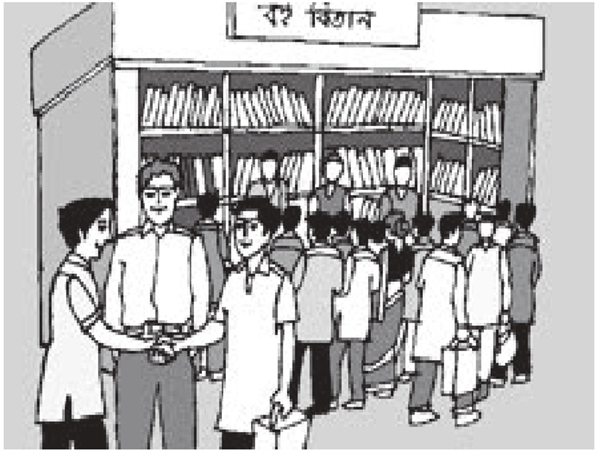
Mamun Akash, I'd like you to meet ______
Akash Hello! My name is Akash. I'm sorry, I couldn't catch your name.
The stranger James. James Collins. Nice to meet you.
Akash Nice to meet you, too. Where are you from, James?
James I'm from England.
A1 . Imagine that you are at a bus/railway station. A friend introduces you to somebody. You couldn't hear his/her name properly for the sound around. Now, make a conversation among you, your friend and the new person.
ii) Sometimes the same questions can be asked in a different way. Here is a conversation between an Immigration officer and a passenger at the Shahjalal International Airport, Dhaka. Listen to the conversation first and then practise it with a partner.
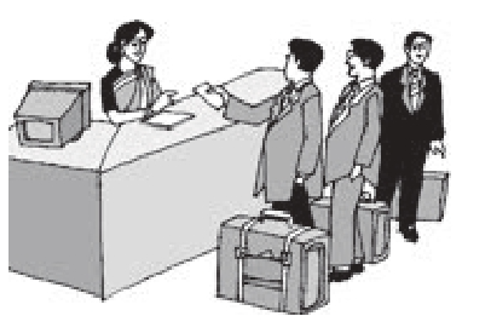
Officer Your name, Sir?
Passenger Robert Smith.
Officer Where do you come from, Mr. Smith?
Passenger Australia.
Officer And where are you coming from now?
Passenger I'm coming from London.
Officer Welcome to Bangladesh, Sir. Have a nice stay.
Passenger Thank you.
A2 . In the above conversation the officer asks the passenger first time "Where do you come from?" and again he asks the passenger "And where are you coming from now?" Why?
iii) It's the first day in the new class after the annual exam. The boy sitting next to Joy is a new student. Listen to and practise the conversation below.
Joy Hello! I'm Joy. I'm the class captain.
New student Hi! My name is Sajed.
Joy Where do you come from, Sajed?
Sajed I'm from Sylhet. My father got transferred here. That's why I'm here in Khulna.
Joy Well, I'm sure you will like Khulna and your new school.}
Sajed I know I will. Will you be my friend?
Joy I'm already your friend!
Joy asks Sajed "Where do you come from, Sajed?" What could Joy ask him instead?
iv) Mamun and Akash are talking about Mamun's cousin Ruma. Listen to and practise the conversation in pairs.
Akash What does your cousin do, Mamun?
Mamun She is an architect. She mostly designs offices and shopping complexes.
Akash What is she doing at the moment?
Mamun Well, at the moment she is designing something different. She is designing a school building at the outskirts of Dhaka.
v) Mary and her mother are sitting in their living room. Mary's mother Rabeya Begum is watching TV and Mary is reading a story book. Their neighbour's little boy is crying at the top of his voice.
Rabeya: I just don't understand! That boy is screaming so much! Maybe he is hungry.
Mary I don't think so. Maybe he is crying for his mother.
Rabeya Why, what does she do?
Mary She works part-time at the Town Hall Library.
A4 . Listen to the conversation between Akash and Mamun, and between Rabeya and Mary again. What difference do you find in the questions "what is she doing at the moment?" and "what does she do?"
Language Focus
| Notice that sometimes the answer to "Where do you come from?" or "Where are you from?" is the name of the country one belongs to. But when both the speakers are from the same country, the question would obviously mean what part of the country one belongs to. Notice the difference between "What do you do?" and "What are you doing?" 'What do you do?' means the same as 'What's your profession?' On the other hand, 'What are you doing' refers to what you are doing at the moment, or something you are doing around that time. |
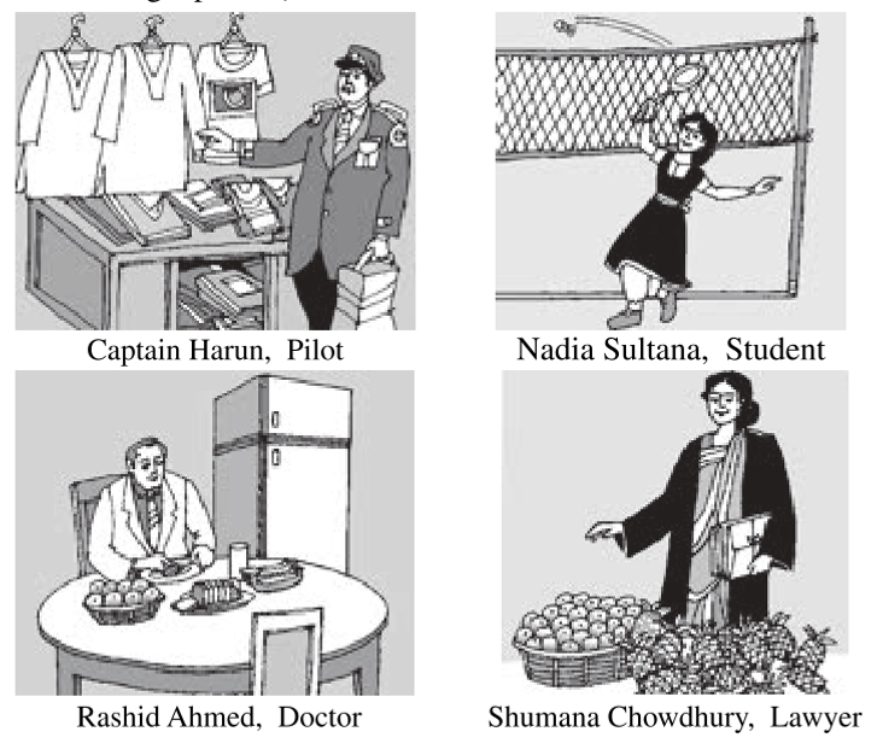
Look at the pictures below. Ask and answer questions about what each person's profession is, and what he or she is doing at the moment.
Follow this model:
What's his/her name? What does he/she do?
What is he/she doing now?
At the moment he/she is _________
He/she is not _______(not doing what he/she usually does, e.g. He is not seeing a patient)

Read more